
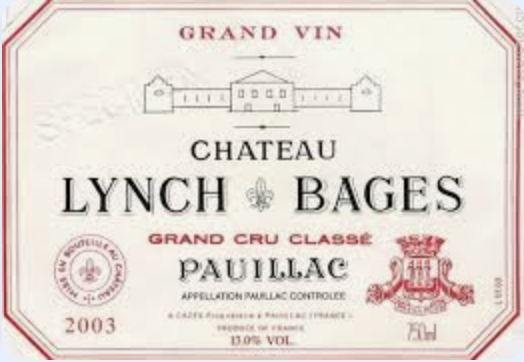
2003 Chateau Lynch-Bages
The 2003 Château Lynch-Bages is one of the most powerful and distinctive wines from a historic Pauillac estate that has consistently outperformed its Fifth Growth classification. Originally part of the Lynch family holdings in the 18th century and revitalized under the Cazes family since 1939, Lynch-Bages has built a global reputation for producing bold, age-worthy Cabernet-driven Bordeaux with remarkable consistency. By the early 2000s, Jean-Michel Cazes had firmly positioned the estate as one of Bordeaux’s premier “overachievers,” blending traditional Pauillac character with modern polish. The estate’s gravel-rich vineyards on the Bages plateau contribute to its signature structure, concentration, and longevity. The 2003 Bordeaux vintage was defined by one of Europe’s most extreme heatwaves, resulting in unusually ripe, opulent wines. While some estates struggled with overripeness, Lynch-Bages excelled due to meticulous vineyard management and terroir resilience. The blend was approximately 72% Cabernet Sauvignon, 16% Merlot, 9% Cabernet Franc, and 3% Petit Verdot.
- $225.00
- $145.00
2003 Chateau Lynch-Bages
The 2003 Château Lynch-Bages is one of the most powerful and distinctive wines from a historic Pauillac estate that has consistently outperformed its Fifth Growth classification. Originally part of the Lynch family holdings in the 18th century and revitalized under the Cazes family since 1939, Lynch-Bages has built a global reputation for producing bold, age-worthy Cabernet-driven Bordeaux with remarkable consistency. By the early 2000s, Jean-Michel Cazes had firmly positioned the estate as one of Bordeaux’s premier “overachievers,” blending traditional Pauillac character with modern polish. The estate’s gravel-rich vineyards on the Bages plateau contribute to its signature structure, concentration, and longevity. The 2003 Bordeaux vintage was defined by one of Europe’s most extreme heatwaves, resulting in unusually ripe, opulent wines. While some estates struggled with overripeness, Lynch-Bages excelled due to meticulous vineyard management and terroir resilience. The blend was approximately 72% Cabernet Sauvignon, 16% Merlot, 9% Cabernet Franc, and 3% Petit Verdot.
$225.00
- 750 ML
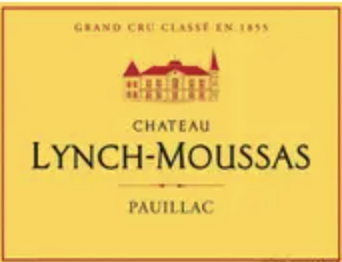
2000 Chateau Lynch-Moussas
The 2000 Château Lynch-Moussas is a superb example of a Fifth Growth Bordeaux that balances power, finesse, and aging potential. Located in the Pauillac appellation, Lynch-Moussas has been in the hands of the Cazes family since 1919, a family also famed for managing Château Haut-Bages-Liberal. The estate’s history is deeply rooted in the classic Médoc tradition: clay-gravel soils atop a subsoil of limestone and sand, perfect for producing Cabernet Sauvignon-driven wines with structure, elegance, and longevity. The 2000 vintage was marked by a warm, dry growing season, allowing grapes to reach full physiological ripeness while maintaining freshness. Château Lynch-Moussas sourced primarily Cabernet Sauvignon, complemented by Merlot and small amounts of Cabernet Franc and Petit Verdot, producing a wine with a deep, ruby-garnet color. On the nose, expect cassis, blackcurrant, cedar, and subtle graphite, with hints of tobacco and cigar box emerging with aeration. The palate shows the classic Pauillac profile: structured yet silky tannins, firm acidity, and a mineral backbone that gives the wine its hallmark balance. While approachable now with careful decanting, this wine has the pedigree to evolve gracefully for another 10–15 years, revealing layers of complexity and secondary aromas.
- $119.99
- $81.00
2000 Chateau Lynch-Moussas
The 2000 Château Lynch-Moussas is a superb example of a Fifth Growth Bordeaux that balances power, finesse, and aging potential. Located in the Pauillac appellation, Lynch-Moussas has been in the hands of the Cazes family since 1919, a family also famed for managing Château Haut-Bages-Liberal. The estate’s history is deeply rooted in the classic Médoc tradition: clay-gravel soils atop a subsoil of limestone and sand, perfect for producing Cabernet Sauvignon-driven wines with structure, elegance, and longevity. The 2000 vintage was marked by a warm, dry growing season, allowing grapes to reach full physiological ripeness while maintaining freshness. Château Lynch-Moussas sourced primarily Cabernet Sauvignon, complemented by Merlot and small amounts of Cabernet Franc and Petit Verdot, producing a wine with a deep, ruby-garnet color. On the nose, expect cassis, blackcurrant, cedar, and subtle graphite, with hints of tobacco and cigar box emerging with aeration. The palate shows the classic Pauillac profile: structured yet silky tannins, firm acidity, and a mineral backbone that gives the wine its hallmark balance. While approachable now with careful decanting, this wine has the pedigree to evolve gracefully for another 10–15 years, revealing layers of complexity and secondary aromas.
$119.99
- 750 ML
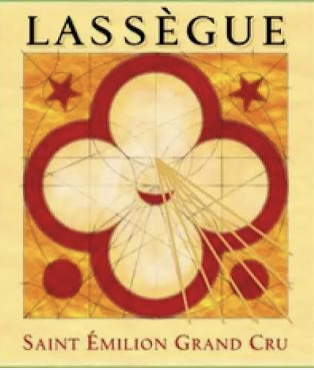
2020 Chateau Lassegue
The 2020 Château Lassègue is a polished Right Bank Bordeaux from Saint-Émilion, produced by Château Lassègue, a historic hillside estate whose origins date back to the 18th century and which entered a new era of quality after its acquisition in 2003 by Jess Jackson and Barbara Banke of Jackson Family Wines. The vineyards sit on prized clay-limestone slopes with varied exposures that allow for optimal ripening, and they are planted primarily to Merlot with supporting Cabernet Franc and Cabernet Sauvignon, a classic blend that yields wines combining richness, structure, and aromatic complexity. Crafted under a philosophy that blends modern precision with traditional Bordeaux techniques, the 2020 vintage shows ripe blackberry, plum, cocoa, and floral notes layered over fine tannins and mineral freshness, resulting in a wine that is approachable in youth yet structured enough for long aging, reflecting both the estate’s historic terroir and its contemporary refinement.
- $74.99
- $48.00
2020 Chateau Lassegue
The 2020 Château Lassègue is a polished Right Bank Bordeaux from Saint-Émilion, produced by Château Lassègue, a historic hillside estate whose origins date back to the 18th century and which entered a new era of quality after its acquisition in 2003 by Jess Jackson and Barbara Banke of Jackson Family Wines. The vineyards sit on prized clay-limestone slopes with varied exposures that allow for optimal ripening, and they are planted primarily to Merlot with supporting Cabernet Franc and Cabernet Sauvignon, a classic blend that yields wines combining richness, structure, and aromatic complexity. Crafted under a philosophy that blends modern precision with traditional Bordeaux techniques, the 2020 vintage shows ripe blackberry, plum, cocoa, and floral notes layered over fine tannins and mineral freshness, resulting in a wine that is approachable in youth yet structured enough for long aging, reflecting both the estate’s historic terroir and its contemporary refinement.
$74.99
- 750 ML
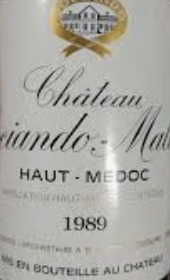
1989 Chateau Sociando-Mallet Cuvee Jean Gautreau
The 1989 Château Sociando-Mallet “Cuvée Jean Gautreau” is a classic mature Bordeaux from the Haut-Médoc appellation, produced by a historic estate whose roots trace back to 1633, when the land belonged to a Basque aristocrat named Sociondo. The modern reputation of the winery is largely due to winemaker and owner Jean Gautreau, a former tennis standout turned wine merchant who purchased the neglected property in 1969, rebuilt its cellars, expanded vineyards from just a few hectares to more than 80, and transformed it into one of the Médoc’s most respected unclassified estates. In 1995 he created the special Cuvée Jean Gautreau, typically made with a higher proportion of Cabernet Sauvignon than the main wine, showcasing the estate’s gravel-and-clay terroir and its capacity for long aging. The house style is traditionally structured and full-bodied, built from classic Bordeaux varieties—generally Cabernet Sauvignon, Merlot, and Cabernet Franc—with blends often around roughly half Merlot and half Cabernet Sauvignon plus a small percentage of Cabernet Franc. Known for dark fruit aromas, minerality, and firm tannins that soften beautifully with age, mature vintages like 1989 highlight the estate’s reputation for producing powerful yet elegant wines that reward long cellaring.
- $139.99
- $73.00
1989 Chateau Sociando-Mallet Cuvee Jean Gautreau
The 1989 Château Sociando-Mallet “Cuvée Jean Gautreau” is a classic mature Bordeaux from the Haut-Médoc appellation, produced by a historic estate whose roots trace back to 1633, when the land belonged to a Basque aristocrat named Sociondo. The modern reputation of the winery is largely due to winemaker and owner Jean Gautreau, a former tennis standout turned wine merchant who purchased the neglected property in 1969, rebuilt its cellars, expanded vineyards from just a few hectares to more than 80, and transformed it into one of the Médoc’s most respected unclassified estates. In 1995 he created the special Cuvée Jean Gautreau, typically made with a higher proportion of Cabernet Sauvignon than the main wine, showcasing the estate’s gravel-and-clay terroir and its capacity for long aging. The house style is traditionally structured and full-bodied, built from classic Bordeaux varieties—generally Cabernet Sauvignon, Merlot, and Cabernet Franc—with blends often around roughly half Merlot and half Cabernet Sauvignon plus a small percentage of Cabernet Franc. Known for dark fruit aromas, minerality, and firm tannins that soften beautifully with age, mature vintages like 1989 highlight the estate’s reputation for producing powerful yet elegant wines that reward long cellaring.
$139.99
- 750 ML
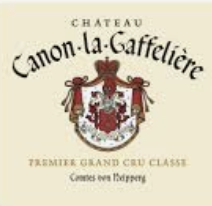
2000 Chateau Canon la Gaffeliere
The 2000 Château Canon-la-Gaffelière comes from one of Saint-Émilion’s most respected estates, historically linked with the Neipperg family and situated on well-drained gravel and clay-limestone soils that favor Merlot and Cabernet Franc blends and produce wines of both power and finesse. The 2000 vintage in Bordeaux is widely regarded as one of the standout millennial years, combining generous ripeness with structure, and Canon-la-Gaffelière’s rendition benefited from meticulous vineyard work and extended oak ageing (about 18 months in new barrels) that helped build depth and complexity. In terms of elite scores, Robert Parker’s Wine Advocate awarded the 2000 vintage 95 points, highlighting its concentration, balance and aromatic intensity, marking it as one of the estate’s most accomplished efforts of that era.
- $199.99
- $95.00
2000 Chateau Canon la Gaffeliere
The 2000 Château Canon-la-Gaffelière comes from one of Saint-Émilion’s most respected estates, historically linked with the Neipperg family and situated on well-drained gravel and clay-limestone soils that favor Merlot and Cabernet Franc blends and produce wines of both power and finesse. The 2000 vintage in Bordeaux is widely regarded as one of the standout millennial years, combining generous ripeness with structure, and Canon-la-Gaffelière’s rendition benefited from meticulous vineyard work and extended oak ageing (about 18 months in new barrels) that helped build depth and complexity. In terms of elite scores, Robert Parker’s Wine Advocate awarded the 2000 vintage 95 points, highlighting its concentration, balance and aromatic intensity, marking it as one of the estate’s most accomplished efforts of that era.
$199.99
- 750 ML